Shopify for fashion and apparel
Shopify for Australian fashion brands
Fashion shoppers want to see the fabric, find their size and know returns are easy. We build Shopify stores that handle sizing, colour variants and sale peaks, so you spend your time on the collection and not on support emails.
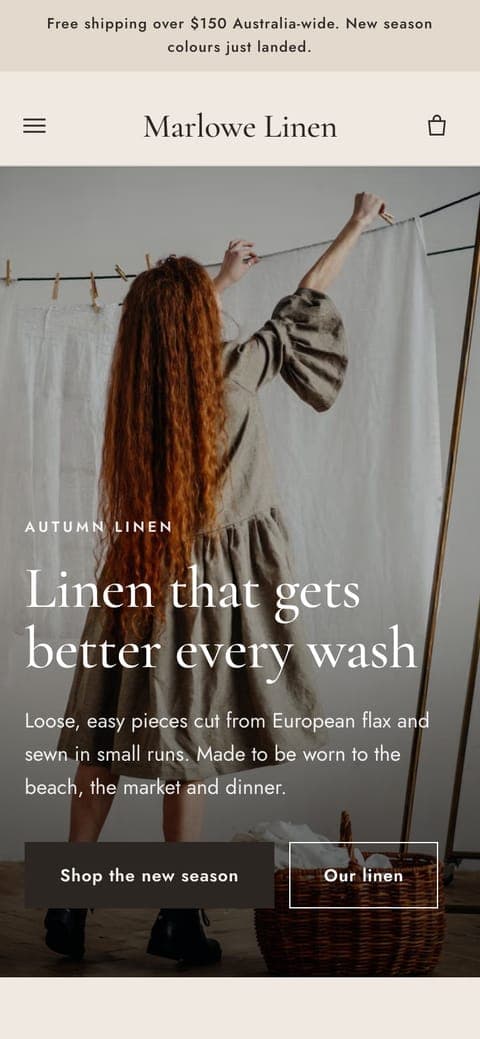
Example store
Marlowe Linen
A quiet, editorial Shopify store for a small-run linen label.
What makes fashion and apparel hard to sell online
Returns and exchanges
Size-related returns are the biggest cost for most clothing stores. A clear size guide, fit notes on each product and an easy exchange flow reduce them better than a strict policy does.
Variants at scale
Colour and size combinations multiply fast. Shopify handles three option types per product, so a good setup uses colour swatches, size availability and a clear stock display without clutter.
Sale peaks
End of financial year sales in June, Click Frenzy, Black Friday, Boxing Day and the Christmas cut-off all compress a year of demand into a few days. Stock, shipping promises and site speed all have to hold.
Photography and speed
Fashion is image-heavy. Unoptimised photos slow a mobile store and cost sales. Image sizing and theme choices matter more here than in most industries.
What we build into the store
Size guides and fit notes
A size chart in a clean modal on each product, with measurements in centimetres, model height and the size worn.
Colour swatches and variant images
Swatches that switch the gallery to the right colour, so shoppers never see the wrong photo.
Back-in-stock and low-stock alerts
Klaviyo or Shopify's own notifications capture demand for sold-out sizes and tell you what to reorder.
Returns and exchanges portal
A returns app lets customers start an exchange themselves, with store credit offered before a refund.
Afterpay and Zip messaging
Instalment pricing shown on product and cart pages, which lifts average order value for many fashion stores.
Collections by occasion and fabric
Smart collections built from tags, so new arrivals and sale pages update themselves.
The Australian rules we design around
Australian Consumer Law gives customers guarantees when goods are faulty, whatever your returns policy says, and you cannot say 'no refunds' on sale items as a blanket rule. Change-of-mind returns are your own policy to set, but it must be clear. Labelling rules apply to garments, so check your labels with a supplier or adviser. Our guide on returns policy under Australian Consumer Law explains the split.
General information, not legal advice. Check with the regulator for your situation.
What a fashion store needs that a generic template misses
A general-purpose theme will show your products. It will not answer 'will this fit?' Fashion stores that convert well put fit information where the decision is made: model measurements, a size guide that opens in context, clear fabric detail and a stated returns policy near the add to cart button.
Our concept store Marlowe Linen shows how that looks in practice. It is a concept we designed, not a client, so we do not quote results for it, but you can see the size and fabric patterns working in a full store.
Planning for sale season
Australian fashion trades on a calendar. EOFY clearance, Click Frenzy, Black Friday, Boxing Day and the last Christmas postage dates each need different prep. We plan discounts, shipping cut-off messaging, email flows and speed checks ahead of each one.
- Set Christmas postage cut-off dates from Australia Post's published dates, and show them in the announcement bar.
- Use Shopify Flow to tag sale orders so the warehouse can pick them first.
- Test checkout on mobile with Afterpay and Zip a week before the event.
- Pre-build the abandoned cart and browse abandonment flows in Klaviyo. See Klaviyo flows for Shopify.
Shipping, GST and selling to New Zealand
Most Australian fashion stores ship by Australia Post or Aramex, often with free shipping over a threshold you choose. We set rates and thresholds in Shopify, and GST so prices show correctly. NZ is the usual first export market, and Shopify Markets handles NZ pricing and duties messaging. See Shopify Markets for selling to New Zealand.
A new fashion brand usually starts on the Launch package, while an established label with its own look moves to Custom. See pricing, or talk to us.
What a good fashion product page needs
The product page is where a fashion sale is won or lost, so every question a shopper has before checkout should be answered on it. The goal is to remove the reasons to leave and to email you instead.
- Price with GST included, and Afterpay or Zip instalment messaging directly under it.
- A size selector that shows which sizes are in stock, with out-of-stock sizes greyed out and a back-in-stock sign-up beside them.
- Model height and the size the model is wearing, next to a size guide with measurements in centimetres.
- Fabric composition and care instructions in plain words, kept in metafields so every product uses the same layout.
- A fit note based on real return reasons, such as 'runs small, size up if between sizes'.
- A gallery with on-body shots, a close-up of the fabric and a flat lay, with variant images that switch when the colour changes.
Reviews help most when they carry fit feedback. Judge.me, Okendo and Stamped can all ask buyers how a garment fitted, which gives the next shopper something more useful than a star rating. Keep the page light, because image-heavy pages are where mobile speed slips. Our speed guide covers how we keep them quick.
Apps we use for fashion stores
Shopify's built-in features cover a lot, so we add an app only when it does a job the platform cannot. A typical fashion store ends up with a short list.
- Shopify Search & Discovery for filters on colour, size, price and availability, and for search synonyms such as 'jumper' and 'sweater'.
- Klaviyo for welcome, abandoned cart and back-in-stock emails. See Klaviyo flows for Shopify.
- Kiwi Sizing or a similar size chart app, if your size guides vary a lot by product type.
- A returns app such as AfterShip Returns or Loop, so customers can start an exchange and be offered store credit first.
- Shopify Flow to tag sale orders, flag large orders and notify the team when a size runs low.
- A reviews app, either Judge.me, Okendo or Stamped, chosen for the fit questions it supports.
Every app adds some code to the storefront, so we test speed after each install and remove anything that does not earn its place. If you already run apps that slow the site, an audit under Shopify apps and integrations is a good place to start.
Common questions
Which Shopify theme is best for a fashion brand?
It depends on your catalogue and brand. We start from your products and build or style a theme around size selection, colour swatches and image quality. A premium theme suits a first store, and a custom one suits an established label.
How do I reduce size-related returns?
Show measurements in centimetres, state the size the model wears, add fit notes such as 'runs small' from real return reasons, and offer exchanges before refunds.
Can Shopify handle hundreds of colour and size combinations?
Yes, though a product is limited to three option types, so colour, size and one more. The variant total per product is large enough for nearly all apparel.
Do I have to offer change-of-mind returns?
No. Australian Consumer Law guarantees remedies for faulty goods, but change-of-mind returns are your choice. State your policy clearly. See our returns guide for the detail.
What about selling in New Zealand?
Shopify Markets lets you show NZ dollar pricing and set NZ shipping rates. We configure it during the build.
Do I need a paid app for size guides?
Not always. A size chart can be a page or a metafield displayed in a modal, which costs nothing. An app such as Kiwi Sizing helps when you have several size charts by garment type or want a size recommender.
How should I show sale prices?
Use Shopify's compare-at price so the original price shows struck through. Only show a was price if the item was genuinely sold at that price, because misleading price claims fall under Australian Consumer Law.
Further reading
Guide9 min read
Writing a returns policy that complies with Australian Consumer Law (and setting it up in Shopify)
You can choose your change-of-mind rules. You cannot take away a customer's right to a remedy when something is faulty. Here is how to write both into one page and set it up in Shopify.
Guide9 min read
Afterpay, Zip and Shop Pay Installments on Shopify in Australia
Buy now pay later is a normal part of Australian checkout. Here is what Afterpay, Zip and Shop Pay Installments mean for a Shopify merchant: setup, fees, payouts, and what the 2025 regulation changed.
Guide9 min read
Klaviyo flows for an Australian Shopify store, and the Spam Act rules behind them
A handful of automated flows does most of the work in email. Set them up once, check consent properly, and let them run.
Tell us what you sell
A few lines about your store and where it's at. We reply within one business day with questions or a fixed quote.