Shopify for kids and baby
Shopify for Australian kids and baby brands
Parents read the fine print on anything their child will touch. We build Shopify stores for toy, nursery and baby brands that show safety information up front, handle gift bundles and keep up with Australian product safety rules.
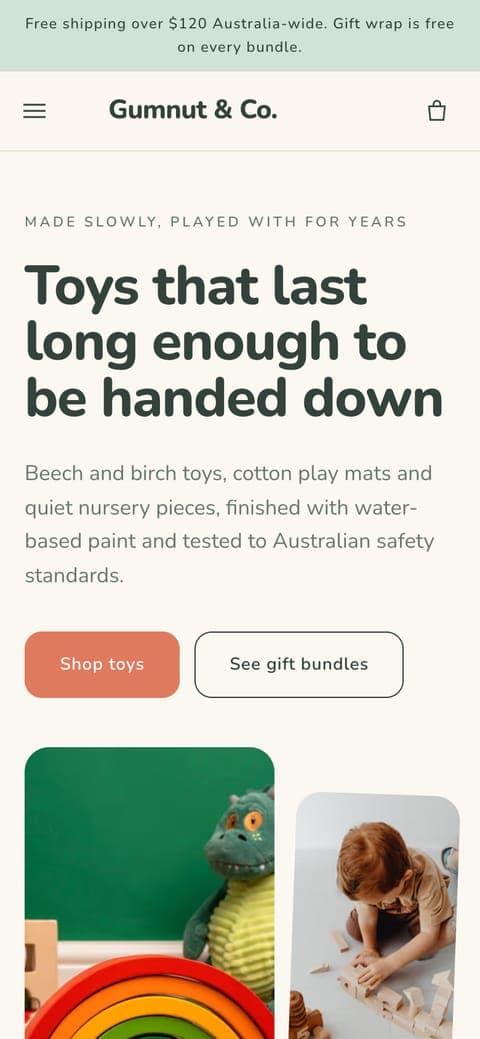
Example store
Gumnut & Co.
A concept store for a wooden toy brand where safety information is easy to find.
What makes kids and baby hard to sell online
Product safety rules
Many children's products are covered by mandatory Australian safety or information standards. Suppliers are responsible, including online sellers and importers.
Trust
Parents want age ranges, materials, testing and care details clearly stated, and are quick to leave if something looks vague.
Gifting
Baby showers, birthdays and Christmas drive gift buying, with bundles, gift messages and delivery dates all mattering.
Recalls and traceability
If a product is recalled, you need to know who bought it and how to contact them.
What we build into the store
Safety and age information
Structured fields for age range, materials, standards met and care, shown on every product page.
Gift bundles
Pre-built and build-your-own bundles, with gift messages and gift cards.
Registry-style wishlists
Lists that parents can share with family for showers and birthdays.
Age and category filters
Collections and filters by age, type and developmental stage.
Customer records for recalls
Order and contact data kept in a way that supports a recall notice if one is ever needed.
Afterpay and Zip
Instalments for larger nursery purchases, shown on product and cart pages.
The Australian rules we design around
Several mandatory standards apply to children's products in Australia, and the ACCC enforces them. Toys for children up to 36 months are covered by a mandatory safety standard, which includes requirements on small parts and, for toys with batteries, on securing the battery compartment. Separate standards cover items such as cots. Button and coin batteries, and consumer goods that contain them, are covered by mandatory safety and information standards, with warnings and secure compartments required. Suppliers, including importers and online sellers, are responsible for compliance, and the ACCC has issued penalties for non-compliance. Check the ACCC's Product Safety Australia pages for the current standard for each product, and keep your test evidence. We build the pages so required warnings and information appear clearly, but we do not certify products.
General information, not legal advice. Check with the regulator for your situation.
Safety information that parents can see
A product page for a baby product should answer the safety questions before the customer asks. Age range, materials, testing and care sit near the price, not buried under a tab. Where a mandatory information standard requires a warning, we make sure it appears as the standard expects, such as on the page and with the product.
Our concept store Gumnut & Co shows safety-tested wooden toys and gift bundles. It is a concept we designed, not a client, and does not stand for real certification.
Gift bundles and the sale calendar
- Bundles for new baby, first birthday and baby shower, with a gift message.
- Christmas postage cut-offs shown from Australia Post's published dates.
- Black Friday and Boxing Day offers that do not undercut your range.
- Gift cards for relatives who prefer to let parents choose.
Email flows through Klaviyo cover birthdays and growth stages. See Klaviyo flows.
Returns, shipping and stock
Parents expect easy returns on gifts. Your policy is yours to set, but faulty goods always need a remedy. See returns under consumer law. Larger items like cots or play mats use weight and size rates. Read our shipping guide.
Custom suits most established kids brands. See pricing or contact us.
What a good kids and baby product page needs
Parents read the details, and regulators expect the safety information to be visible. A good page serves both.
- The age range the product is designed for, as the manufacturer states it.
- Required warnings and instructions, shown clearly on the page and not buried in a tab.
- Battery information for any product that uses button or coin batteries, matching what is on the pack.
- Materials, dimensions, weight and what is included.
- Assembly, installation and care instructions, with a link to the full manual.
- Plain language about what the product is and is not, without safety claims you cannot support.
Do not call a product safe, non-toxic or certified unless you can show the evidence. Keep test reports and supplier records in your own files, since the supplier carries the responsibility. We can add internal notes or fields to the product, and we make the required information easy to find, but we do not certify products.
Apps and planning for kids and baby stores
Baby shopping runs on events, so the store should make gifts, bundles and reminders easy.
- Shopify Bundles for gift sets, such as a newborn pack with a swaddle, bodysuits and a toy.
- Shopify gift cards for last-minute presents.
- A wishlist app such as Wishlist Plus, so families can share what they want.
- Klaviyo flows that ask for a due date or child's age with clear consent, and use it only to time relevant emails.
- Shopify Flow to tag orders by product, which helps you contact buyers quickly if a recall ever happens.
Baby showers and birthdays happen all year, with spikes at Mother's Day, Father's Day, Christmas and the back-to-school period. Use clear delivery cut-offs before gifting dates. Afterpay and Zip messaging suits higher-priced items like prams and car seats. See Afterpay and Zip on Shopify for the setup.
Common questions
Do mandatory safety standards apply to online sellers?
Yes. The standards apply to suppliers, which includes manufacturers, importers and retailers selling in Australia, online or in a shop.
What do I need to show for products with button batteries?
Mandatory standards cover the products and require warnings and secure battery compartments. Check the ACCC's guidance for exactly what applies to your product.
Can you add a baby registry?
We can build shareable wishlists and gift lists with an app.
Does Shopify help with recalls?
Shopify holds your customer and order data, so you can contact buyers. We set up exports so you can find affected orders quickly.
Can you certify my products?
No. Testing and compliance sit with you and your testing provider. We make sure the store shows the information clearly.
Where should I keep test reports and supplier documents?
Keep them in your own records with your supplier files, organised by product. In Shopify we can add an internal note or metafield that points to the right document, but the documents themselves should stay under your control.
Can I use age and category filters?
Yes. Search & Discovery from Shopify supports filters on product tags and metafields, so you can offer age range, category and price. Make sure the age data is accurate on every product.
Further reading
Guide9 min read
Writing a returns policy that complies with Australian Consumer Law (and setting it up in Shopify)
You can choose your change-of-mind rules. You cannot take away a customer's right to a remedy when something is faulty. Here is how to write both into one page and set it up in Shopify.
Guide9 min read
Afterpay, Zip and Shop Pay Installments on Shopify in Australia
Buy now pay later is a normal part of Australian checkout. Here is what Afterpay, Zip and Shop Pay Installments mean for a Shopify merchant: setup, fees, payouts, and what the 2025 regulation changed.
Guide9 min read
Klaviyo flows for an Australian Shopify store, and the Spam Act rules behind them
A handful of automated flows does most of the work in email. Set them up once, check consent properly, and let them run.
Tell us what you sell
A few lines about your store and where it's at. We reply within one business day with questions or a fixed quote.